it's not easy to make a big splash in the pickup truck world but that's
exactly what Ford wants to do by bringing back the 2019 Ford Ranger so we
thought it would be a good idea to put it up against the top seller in the
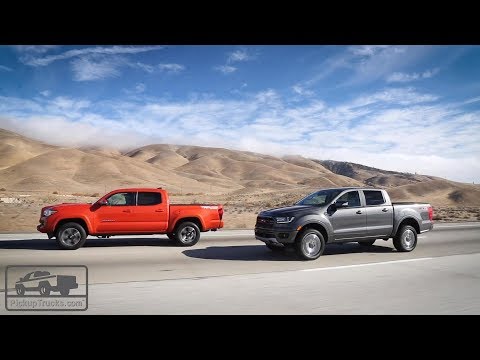
mid-size segment so we've got Tacoma against the Ranger
I'm here with West Coast editor for cars comm Brian Wong Brian I want to give you
some numbers and then I want your impressions of these vehicles we've got
it sounds good the Tacoma the 3.5 liter v6 278 horsepower 265 foot-pounds of
torque the new Ranger only comes in a four-cylinder 2.3 liter EcoBoost as a
pretty good sized turbocharger but it's 270 horsepower 310 foot-pounds of torque
how did they drive on road yeah I think that the difference in torque really
sticks out in favor of the Ranger one of our long-term complaints about the
Tacoma has really been the peak eNOS of that engine but I thought the Ranger had
a lot more even power delivery on-road off-road and it just made it more fun to
drive overall okay so when we did Canyon carving we went up and over a few
mountain ranges which one was more fun to drive oh the port for sure and that
because you didn't really have to put your foot in it to get to go there's a
pretty willing participant from even mid throttle very quick throttle response 10
speed transmission probably there's a lot of good too it's got a sport mode
but it has a very very touchy almost throttle so when you want to go all you
do is put your foot into it you're gone yeah this Ford 10 speed automatic
transmission has started to make its way into more and more Ford products as well
as GM products and I would say that it's done pretty well and pretty much all
applications and today it did everything that we could throw at it with you know
great vigor but I know there's a lot of Toyota guys out there screaming at us
what about the transmission button yet you have to push to change the algorithm
and formatting of the software in the transmission that helps a lot and then
it's got a sport mode you can flip over and instead of the thumb drive
transmission you have on the Ford you've actually got a shifter yeah the shifter
to move through the gears on the Toyota is a much more
it's a preferred way to kind of do that it feels more mechanical you feel more
in tune with the truck rather than just kind of using
thumbless to to flip through gears but at the end of the day I'm still taking
the Ranger I'm still taking that advantage into work and I'm still taking
that very consistent water delivery whether you're in a sport mode or not so
when you're distant drive the Ranger is far better and when you're in sport I
still think it edges it so more fun to drive but how did it do during our fuel
economy testing it's interesting because you would automatically kind of give the
big advantage to the smaller engine but in this case they actually came out
basically in a dead heat after our 270 or so mile drive that we did the other
day on roads so you're not quite getting the advantage of fuel economy that you
think from a 4-cylinder but again I think the performance kind of makes up
for it so more fun to drive gets fairly good yeah
enemy but the v6 and the 4-cylinder do pretty much the same thickness yeah and
that's kind of what Toyota was going for with his v6 right it kind of switches
cycles on you so it starts on the atkinson cycle which is more efficient
and i think that that's really how able to keep up with this truck in terms of
fuel economy as you might expect a lot of differentiation here in the interiors
this is the ranger lariat model so we've got nicely contoured front seats leather
wrapped also soft touches both in the center console on the door so your
elbows don't get roughed up and also here on the dash itself this is a softer
material it's not the hard plastic that we see on the XL or the XLT
much more organic layout more horizontal nice big 8 inch color screen here for
the navigation and a lot of cubby spaces in the doors also in the front and
cupholders here in the center here in the backseat the Ranger also
differentiates itself with Tacoma in a few key ways the first is more charging
options the back that become was very Spartan no air vents to the backseat
passengers no even charging options but here in the back of the Ford you get two
USB ports and a 110 volt three prong household outlet now that joins two USB
ports up front and two more 12-volt up front so that you keep all your devices
charging the Ranger and that's something that modern people really need
especially those with kids so if you're gonna use this also as a family vehicle
that's a really important consideration also on the Ranger back seat folds up
and folds down no storage behind the seat here but underneath to decently
sized cubbies for you to fit two and other things that you really want to
keep in the truck now those charging ports are another way in which the
Ranger interior really kind of leaps ahead of a Tacoma that stink multimedia
system has Android auto ball car plate in just a cleaner overall user
experience Toyota really needs updates multimedia system and the Tacoma is no
exception so we started out with the interior the Ranger which is the one
that I would say that we clearly liked better Toyota
no slouch in that department we actually like the styling of this a lot the dials
and the whole dashboard here looks more rugged mark talking about the horizontal
integration of the Rangers dashboard so they're definitely more vertical all of
your controls be kind of stacked up here in the center console there's not a
whole lot going on on the right side of the cabin at all really just focuses
down to the center now as we mentioned screens definitely better than the Ford
it has those my Ford touch screens in the instrument panel it also has a
larger touchscreen the center console so you had a smaller touchscreen but it's
also missing connectivity options no lanes right Auto no apple carplay in the
Toyota infotainment system is one that we've been asked them to update for
years so when I do get updated in there are other vehicles hopefully those
changes do come to the next generation of Tacoma one thing to mention that it
does do well it has a large wireless charging pad so if you have a smart
phone with wireless charging it's actually big enough to fit even the
larger smartphones of today with the case on so my phone fits in there fine
not always the case in different vehicles one other thing that we do like
about the Toyota interior this shift knob here the shift action when you're
doing up and down and locking out gears much better than the thumb shifter
that's on the Ranger mark how about the backseat yeah the key word back here is
Spartan very limited in legroom Headroom a little bit more cramped than the
Ranger also no AC vents no charging ports here and back what they do offer
is a little bit of storage under the seat bottom seat slips forward and if
you fold forward the seat backs there's also some hidden storage back there as
well here at the back of the trucks not a lot of creativity not a lot of
complexity but there are differences what what are you seeing between these
two the most obvious difference is that we have a composite bedliner in the back
that the coma it was spray in bedliner in the back of the the Ranger and this
composite bed later probably helps the Tacoma on overall on weight but it does
you know have kind of a slippery floor that you don't really get with the
Ranger there is one thing about the tacomas bed that is heavier and that
would be the tailgate so back here steel on the Ford it is aluminum and
much easier to lift up you can even do it with two or three fingers now the
Toyota tailgate is strutted so it actually softly releases so thick that
it does yeah but the Ranger does not have that option but it is very light so
it's very easy to close all right we also took these to the scale the truck
scales and found out some very interesting details about payload yeah
so you have a very big advantage in payload overall payload for the Ranger
so that checks in at about 1500 pounds of payload as we wait at the scale it's
a combo you're down around a thousand pounds and that's a 50% difference in
payload between the two vehicles and very interesting we found out that they
both of these vehicles are both crew cabs both four-wheel drive both 5 foot
beds weigh about the same thing with 20 pounds of each other yeah really close
in weight but since the gbw number is so much higher on the Ford they get 4 500
pounds more payload capacity yeah maximum payload capacity which is super
cab 2-wheel drive version is over 1,800 pounds so way higher than anything
Toyota and for that matter anything Colorado Canyon or frontier can offer
right and that will kind of be a big selling a big selling or detracting
point for one of these trucks for consumers who are gonna be hauling a lot
of stuff so if you're gonna have to carry anything that's over a thousand
pounds that immediately disqualifies it Acoma for you and leaves you with the
Ranger the last thing I want to make sure we talk about at the back of the
trucks here their rear axles very interesting strategy Tacoma still has
drum brakes they both use monotube shocks and a four leaf pack suspension
in the Tacoma but basically a one leaf package in the Ranger that still has
more payload than anything else yeah it's impressive for what they're able to
do we did get a chance to go play with these vehicles off-road but we should
note this is the top level Ranger it has the FX 4 package four-wheel drive but
Toyota we have the TRD sport there's still a TRD off-road and a TRD pro level
above that so a fairly level comparison but not identical Brian talked to me
about how much fun we had first of all and then what what technology in each of
the vehicles kind of allow that to have yeah
I think it's safe to say that both of us weren't impressed by what each truck was
able to accomplish on the Toyota side it's the TRD sport so it doesn't have
plated as crawl control system which we've enjoyed in the past but even on a
street tire it was able to kind of handle everything that we threw at it
from a Hill Climb to going through ruts to even a rock crawling section the
suspension flex and the coma and the amount of you know ease with which it's
able to kind of traverse obstacles very impressive for not their top level
off-road truck now on the fort side comes with trail control they're kind of
virginal crawl control and much too the way that Ford has kind of endorsed it
it's quiet you go crawl controls kind of loud you can hear all the mechanical
linkages kind of working on the Ford you just slap it in there take your foot off
the gas take your foot off the brake and it crawls out with nary a sound so it's
a much quieter that feels like a much smoother system except for in one
instance and that would be rock crawling so for some reason the trail control
system on the Ford kind of when you get over a rock or when you get over a lip
it gives you like a little bit of rock back and it's very disconcerting when
you're on a trail and you're trying to get over something and be smooth to have
the system feel like it's gonna rock back on you at a certain point I kind of
just took control and I was like you know the truck the trill bitch was doing
real well I think I can do a little bit better and I don't know if I've ever had
that feeling with crawl control ya know we both have had a lot of experience
with Toyota's crawl control and we've although we've always am constantly are
commenting about how noisy it is when you know those brakes are going on and
off the trail control much smoother much quieter more organic almost as it climbs
over those obstacles but yeah you're exactly right in those situations where
we were going up the steep grades and that throttle wasn't quite enough to
keep that vehicle locked down it almost was if it was prevented from
using the brakes to keep it from rolling backwards it got a little rolling
backwards in some cases maybe even a foot or maybe more than a foot before
the throttle kicked in and actually brought that back up to speed and you
held your ground and then eventually the traction found its way forward and maybe
we've been overly I guess critical we might be of the word about crawl control
and it's noises because I think that there is some comfort in hearing the
traction control and hearing the brakes working concert so well with the
powertrain on the Toyota the Ford we got there we're like oh we
don't want sound well maybe that's not the best you know the grass isn't always
greener on the other side recommendations that we obviously have
for anybody thinking about these vehicles first thing you want to think
about is putting a good off-road maybe all-terrain yeah or if you're gonna do
any off-roading but secondly maybe wait for the Ford Ranger Raptor we keep
hearing rumors about that coming down the road that can't be very difficult to
make no I think that's coming and I think that if you're gonna do some real
serious off-roading in the Ranger that might be the one to wait for but I will
say this the fx4 was really impressive on dirt so kind of how the Raptor has
made its name as a dirt runner the fx4 does a very good impression we took it
over some washes at 3040 miles an hour suspension felt very stable that
powertrain really responsive easy to manipulate the throttle through corners
so you can kind of get the tail to swing out a little bit as we did a few times
great fun in the wash yeah Ford engineers have dialed in the suspension
both on pavement and for all sorts of off-road use which we experienced today
yeah I think that the Ranger just it drives really well and I think that
that's something you could say about it both on Road which we experienced
yesterday and off-road with the experience today and that's a really big
compliment to pay for a truck especially something in this segment where there
are other trucks that don't necessarily drive as well in one condition or the
other so there you have just some of our thoughts about some very specific
categories about how these two trucks compare with one another but we have no
doubt if this new Ranger is going to do this well against the top seller
consumers are very likely to respond well to for more details and to find out
who won our competition go to pickup trucks calm
you
you

Không có nhận xét nào:
Đăng nhận xét