Thứ Hai, 2 tháng 7, 2018

Auto news on Youtube Jul 2 2018

concussion is a mild traumatic brain injury that affects normal brain

functions it occurs as a result of a forceful blow either direct or indirect

to the head an example of an indirect blow is a whiplash type injury that

causes the brain to shake quickly back and forth inside the skull in a direct

blow injury may develop on the side of contact with the force or on the

opposite side of the head concussion may be caused by Falls

contact sports motor vehicle accidents or physical abuse brain injury can occur

with translational rotational or angular movements of the head rotational and or

angular forces cause the brain to twist against the brainstem the thin stalk

that connects the brain to the spinal cord and damaged the structures within

because the brain stem controls many vital bodily functions including

consciousness rotational and angular injuries usually result in loss of

consciousness and are often more serious concussion is a functional injury rather

than structural a concussed brain usually looks normal on a brain imaging

test the damage occurs at a microscopic level and generally affects a large area

of the brain the mechanical impact exerted by the blow sends shockwaves

that diffuse through the brain tissues stretching and possibly shearing

membranes of neurons especially along the long axons that are responsible for

transmitting signals from one neuron to another the events that take place

during and after concussion are complex and not fully understood but likely to

involve ionic imbalances and energy crisis due to reduced blood flow ionic

disturbances such as abnormal potassium efflux and calcium influx interfere with

action potential dynamics disrupting normal communication between neurons

reduced blood supply impairs cellular functions and makes the brain more

vulnerable to further damage children and teens are at greater risks for brain

injury because their brain is still developing and therefore more

susceptible to insults axons and young brains are not fully myelinated easier

to get damaged and take longer to recover brain development may also stop

for some time after sustaining a concussion signs and symptoms of

concussion can be subtle it may not appear immediately it is common for the

first signs to show up after 20 minutes 2 hours from the time of impact common

symptoms include headache drowsiness dizziness sensitivity to light loss of

memory difficulty concentrating and feeling slowed down patients should be

observed for at least 48 hours for worsening signs such as loss of

consciousness increasing headache repeated vomiting slurred speech

confusion unusual behaviors seizures and limb weakness or numbness any of these

would require emergency care concussion usually resolves on its own with proper

physical and cognitive rest the majority of people fully recover after a couple

of weeks but some may take longer during recovery the brain is much more

vulnerable to further insults and any activities that may potentially cause

another impact should be avoided a repeated injury while the brain is

recovering may exacerbate symptoms result in permanent brain damage

and can be fatal

For more infomation >> Concussion: Pathophysiology, Causes, Symptoms and Treatment, Animation - Duration: 4:18.

-------------------------------------------

Hairfall Control Treatment with NUTRILITE - Duration: 10:25.

Please Please Subscribe Zaroor Kare.. Subscribe my channel for more such videos

Please Please Subscribe Zaroor Kare.. Subscribe my channel for more such videos

Please Please Subscribe Zaroor Kare.. Subscribe my channel for more such videos

Please Please Subscribe Zaroor Kare.. Subscribe my channel for more such videos

Please Please Subscribe Zaroor Kare.. Subscribe my channel for more such videos

Please Please Subscribe Zaroor Kare.. Subscribe my channel for more such videos

Please Please Subscribe Zaroor Kare.. Subscribe my channel for more such videos

Please Please Subscribe Zaroor Kare.. Subscribe my channel for more such videos

Please Please Subscribe Zaroor Kare.. Subscribe my channel for more such videos

For more infomation >> Hairfall Control Treatment with NUTRILITE - Duration: 10:25.

-------------------------------------------

State of Addiction: Drug treatment relieves symptoms of withdrawal from opioids - Duration: 2:47.

For more infomation >> State of Addiction: Drug treatment relieves symptoms of withdrawal from opioids - Duration: 2:47.

-------------------------------------------

Frozen Shoulder Treated in One Minute (Hindi, English CC) by Sachin Goyal-फ्रोजन शोल्डर कंधे का दर्द - Duration: 2:20.

Namaste! I am Sachin Goyal and I welcome you to this program for public welfare.

Friends, Do this exercise and use this home remedy to cure frozen shoulder, shoulder pain forever permanently.

Exercise for shoulder pain is that place your index and middle finger on wall in front of you.

Now crawl your fingers upward like this so that your arm moves up slowly.

Move it to the highest point you can.

Now move fingers downwards back to the starting position.

This exercise is known as wall climbing exercise.

You should do up and down movement 4-5 times.

Try to move hand higher than previous with every repetition.

You can do this exercise 2 times a day.

It cures frozen shoulder, shoulder pain very quickly.

I saw that people get cured their pain within a week completely,

their hand started to move up like a normal person and yes they also became able to turn the hand back.

You must do this exercise. It will cure frozen shoulder, shoulder pain forever, permanently.

To prepare home remedy for shoulder pain you will need aloe vera, turmeric powder and ginger.

Take 2 tsp aloe vera gel in a bowl.

Add 1 tsp turmeric powder and 1 tsp ginger powder to it and mix it well.

A powerful ointment for frozen shoulder pain is ready to use.

Apply this natural ointment over shoulder and leave it for at least 2 to 3 hours.

Then remove it by washing with plain water.

Friends, aloe vera not only improve digestion but also it is a natural painkiller.

Application of aloe vera gel or juice over painful muscles, joints gives instant relief in pain.

Turmeric and ginger also improves blood circulation in painful areas

which in turn reduce muscle stiffness and make them soft and normal and cures pain.

Friends, using this home remedy will give quick relief in shoulder pain

and it cures frozen shoulder and shoulder pain within a week.

People who are unable to move hand up due to shoulder pain,

they can move their hand up like a normal healthy person by using this.

They can turn their hand back also.

If you have very severe pain, then you can apply this remedy and can leave it overnight.

It will cure shoulder pain of people all age groups.

Just use this natural home remedy and forget you shoulder pain.

Subscribe me at youtube.com/sacgoyal to watch more acupressure tips, health tips, health facts.

Click above boxes to watch my popular videos and click my photo above to Subscribe Me.

For more infomation >> Frozen Shoulder Treated in One Minute (Hindi, English CC) by Sachin Goyal-फ्रोजन शोल्डर कंधे का दर्द - Duration: 2:20.

-------------------------------------------

💉 Second Xolair Shot for Mast Cell Treatment ⚕ - Duration: 11:33.

For more infomation >> 💉 Second Xolair Shot for Mast Cell Treatment ⚕ - Duration: 11:33.

-------------------------------------------

Brain Dural Arteriovenous Fistula BDAVF - What are treatment options? (7) - Duration: 1:43.

- Brain Dural Arteriovenous Fistula, BDAVF - there are many treatment options and they

depend on several important clinical factors.

How do you decide on the best treatment for dural fistulas in the brain?

That depends on the BDAVF location. Dr. Anton Titov MD

Dural fistulas mainly in the anterior fossa - it is surgery.

But if we take all the brain dural AV fistulas altogether - endovascular treatment is the

treatment of choice in most of brain dural fistulas, except for the anterior skull base

fistulas, where surgery is still the number one treatment choice.

You can also do radiosurgery or combined treatment in some of the dural AV fistulas, but whether

to treat or not depends on the symptoms

- whether Dural AV fistula has bled or not, and whether BDAVF has cortical reflux from

venous reflux, which predisposes dural fistula more to rupture than if it doesn't exist.

So those we treat more actively.

If a brain dural AV fistula has a cortical reflux, then you treat it more aggressively

and early.

Exactly!

Even if brain dural fistula has not bled yet, but if the patient has tinnitus or disturbing

bruit in the ear, we treat - we treat dural AV fistulas.

For more infomation >> Brain Dural Arteriovenous Fistula BDAVF - What are treatment options? (7) - Duration: 1:43.

-------------------------------------------

Dr Yaganti on Treatment of Aortic Stenosis - Duration: 1:10.

When I usually talk to patients,

I'd say there are three different ways

we can treat your aortic stenosis.

The first way is medications which don't work

because it's a mechanical problem.

The only thing that works is replacing the valve.

The second option which is a more traditional option

is surgery where you undergo open heart surgery

and the surgeon takes your aortic valve out

and then they put a surgical valve in.

The third option which is the latest option is TAVR.

TAVR stands for transcatheter aortic valve replacement.

It's pretty similar to an angiogram

where interventional cardiologists will go through the groin

and take a look at the arteries and the heart.

We can actually replace a patient's valve

using a similar route, not in all patients

but a majority of the patients.

Because the patient is not undergoing sternotomy

and they're not on a heart-lung machine,

so the recovery is much shorter.

The risks associated with the procedures are smaller

compared to other options which is surgery.

For more infomation >> Dr Yaganti on Treatment of Aortic Stenosis - Duration: 1:10.

-------------------------------------------

Dr Nannapaneni on Additional Treatment for Arrhythmia - Duration: 0:23.

They should call their doctor

and inform them that their symptoms are back.

Sometimes, it might require additional medications

along with the cardioversion to hold their rhythm.

Sometimes they may require cardiac ablation

if the medications don't work

or if they don't want to take medications.

For more infomation >> Dr Nannapaneni on Additional Treatment for Arrhythmia - Duration: 0:23.

-------------------------------------------

Improving Drug Delivery in Cancer Treatment - Duration: 1:12.

Some of our successes in understanding how cells do inorganic chemistry led us to discover

the nanobins.

What nanobins are are little lipid droplets — they're kind of fat bubbles — in which

we can crystallize these inorganic drugs and then use that lipid droplet as a cargo bin.

What we've discovered is how to formulate, how to build these up, so that they — when

they're injected — they get concentrated in the tumor, and that drug can then be released

by a chemical process that is going on inside the cancer cell.

So using our knowledge of the chemistry of the cancer cell, using our knowledge of how

vascular biology and how tumors recruit nutrients, we're able to get these nanobins concentrated

in an area where they then can have a triggered release of the drug substance.

The nanobins that don't go into the tumor, then, are often filtered out and removed from

the body so we don't have nearly as much off-target toxicity.

For more infomation >> Improving Drug Delivery in Cancer Treatment - Duration: 1:12.

-------------------------------------------

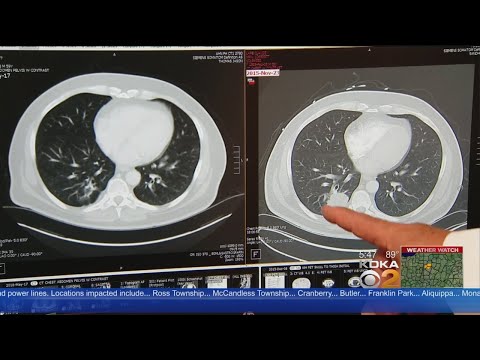
Immunotherapy Being Studied As Possible Lung Cancer Treatment - Duration: 2:57.

For more infomation >> Immunotherapy Being Studied As Possible Lung Cancer Treatment - Duration: 2:57.

-------------------------------------------

Pulmonary Arterial Hypertension treatment options rapidly evolve (2) - Duration: 3:10.

- What is new in treatment of pulmonary arterial hypertension? Dr. Anton Titov MD

- So the treatment of pulmonary arterial hypertension has come a long way since I got involved.

When I first got involved, there was only one drug, well, two drugs - there were calcium

channel blockers, which are pretty ineffective for the vast majority of patients with pulmonary

arterial hypertension, and epoprostenol, which was called Flolan at the time, which is an

intravenous therapy.

Prostacyclin was the other drug.

And it really had a big impact on patients, but it was a very complicated therapy that

involved intravenous continuous infusion, external pumps, and Hickman catheters.

Over the course of the past 20 years the focus in pulmonary arterial hypertension has been

on three main pathways: endothelin pathway, nitric oxide pathway, and prostacyclin pathway.

So there been a number of drugs developed - both intravenous and oral, and even inhaled,

but none of them are home runs.

They're all effective in pulmonary arterial hypertension to a certain extent.

They've had a tremendous impact on survival and functional status, quality of life.

But there's still tremendous room for much more development [of pulmonary arterial hypertension

therapy].

More and more the focus is now on metabolic modulators, things that change mitochondrial

function, things that are antiproliferative, even some chemotherapeutic [medications] repurposing

going on, and also anti-inflammatory targets, in a complicated way.

So I think we're moving much more into the realm where we are starting to treat pulmonary

arterial hypertension like a metabolic neoplastic disease more than a vasoconstrictor disease,

which is what most of the focus has been on.

So for somebody who has been diagnosed with pulmonary arterial hypertension and the diagnosis

has been established, are there stages of therapy or lines of therapy, similar to the

neoplastic disease treatment?

What is a typical progression of treatment for a pulmonary arterial hypertension patient?

- So we grade patient severity of disease much like we do in heart failure.

And we use the WHO functional class approach.

And really over the past two to three years what's become the standard of care for pulmonary

arterial hypertension is using combination therapy, just like we would for most any other

complicated disease.

These drugs for pulmonary arterial hypertension tend to be quite expensive, so there's been

a reluctance over the past years purely because of expense.

Now we have clinical trial data that show clear benefit in pulmonary arterial hypertension

of using a combination therapy.

So, depending on how sick a patient might be

- and by how sick I mean how short of breath, how limited are they?

Are they having issues with heart failure at the time?

We might start out with just oral therapy and using a combination of two drugs.

Usually it's going to be a phosphodiesterase 5 inhibitor in combination with an endothelin

antagonist.

As patients with pulmonary arterial hypertension progress, then we start to think more and

more about prostacyclins.

But the truth is that prostacyclins still are our best therapies and probably if we

use them earlier in disease, we'd get even better results.

So it's a moving target how we treat patients.

But what's good is that it's becoming a more complex targeting of disease or at least a

therapeutic approach to pulmonary arterial hypertension, which I think is having better

outcomes.

For more infomation >> Pulmonary Arterial Hypertension treatment options rapidly evolve (2) - Duration: 3:10.

-------------------------------------------

Nancy Brown: Gender Biases in the Treatment & Care of Non-Communicable Diseases - Duration: 3:17.

- Both in the U.S. and around the world,

there is a bias, or even a discrimination

against women in the health care system.

Often, the diagnosis of cardiovascular diseases

or other diseases, and the treatment patterns

are based upon clinical trials, studies,

and research that have been done largely in men.

When those are superimposed on women,

women may not be getting the specific diagnosis

or treatment that they deserve for their diseases.

For cardiovascular diseases, as an example,

many of the studies on things like statins

and high blood pressure have been done largely

with male populations.

And so, how do we know the right treatment

at the right time for the right person,

if we don't have more women included in studies,

and if we don't find a way to make sure

that our treatments are specific to genders.

In modern society today, you know, women have

an equal right to be represented in the healthcare system.

Women have an equal right to have treatments

that are designed to work for them.

And we must make sure that there are not biases

in the system against women.

Women, for example, who are pregnant and have

gestational diabetes have a much higher risk

of heart disease later in their life,

and we need to get our healthcare systems

to begin asking questions of women

about what was their pregnancy like.

How can we make sure that women have

a continuous treatment of care from their physician

who might treat them in their childbearing years,

to their physicians who might be treating them

later in life.

The wider economy is certainly impacted

because of this bias.

First of all, women may not be getting

the right treatments, so that might mean multiple trips

to the doctor, multiple medications that are tested

before a women gets to the right treatment.

Secondly, some women aren't getting treated at all,

and we know that the cost of delaying healthcare

has a very significant disadvantage to the overall economy.

Thirdly, we recognize that women who are in disadvantaged

areas and may not have access to healthier food,

safe places to exercise, may not be able to manage

and control their risk of many diseases,

will be disadvantaged and the healthcare system

will pay a very steep price.

Stakeholders must come together and be willing

to have the discussion that there is a bias

against women in the healthcare system.

There must be a roadmap for how we assure that women

are included in clinical trials.

That when new drugs and new devices are developed,

that there are those that are able to work

specifically for women.

One example we often like to give, is that for patients

that have very significant heart failure,

and they may be waiting for a heart transplant,

often are given an artificial heart in this interim

time period.

And the only FDA approved artificial heart

in the United States right now, does not fit

most women's bodies.

And so if that isn't disadvantaging women,

I'm not sure what it.

Coordination among all stakeholders is critical

to remove this bias and make sure that women

have equal access to the best of our healthcare systems

and to the best of prevention and treatment strategies.

For more infomation >> Nancy Brown: Gender Biases in the Treatment & Care of Non-Communicable Diseases - Duration: 3:17.

-------------------------------------------

Glioblastoma / High-grade Glioma How treatment options improved? (10) - Duration: 3:00.

- High-grade glioma brain tumor, glioblastoma multiforme, GBM, is the most aggressive primary

tumor of the brain. Dr. Anton Titov MD

It's also one of the most frequent.

What are the treatment options today for patients with glioblastoma?

First, we do surgery if the brain tumor is in such a location that we think it's easily

reachable.

It doesn't mean that we operate all of high- grade gliomas.

Sometimes, if glioblastoma multifocal, very central, close to some very eloquent areas,

we may take only a biopsy, followed by chemotherapy or radiotherapy.

Usually, we start first with radiotherapy and then chemotherapy.

But nowadays more glioblastomas can be operated on straight away.

We don't take biopsy first and then operate.

If we think brain tumor is operable, we operate and try to remove as much as possible, using

all the modern technology, neuronavigation, of course, modern neuroanaesthesia, modern

techniques in surgery as well as gliolan.

It's a dye that is given to the patient, so we can see, looking at the microscope, the

brain tumor looks pink.

And then we can see more of the borders, because high-grade gliomas and glioblastomas are not

sharply circumscribed.

We use ultrasonic aspirator, of course, this is the standard way to remove many of these

brain tumors.

And then we do post-operative MRI to check the results.

Intraoperative MRI is something we will get in our new building, but these modern dyes

that can be used together with the microscope with different wavelengths of the light have

been replacing a little bit of need for intraoperative MRI.

First, surgery, then radiation, and then chemotherapy depending on the exact brain tumor pathology

and potential genetic defects that are found in the brain tumor tissue that may be more

reactive to chemotherapy, for instance.

Then the patients are followed thoroughly with MRIs and clinical checkups And patients

are doing better and better.

We see more and more 5-year surviving patients.

Of course, the malignant high-grade glioma or glioblastoma often recur, unfortunately,

at the surgical resection site, so repeat resections are also possible, it's something

that you are doing.

- Exactly, we do repeat surgery for glioblastomas when indicated and needed.

For more infomation >> Glioblastoma / High-grade Glioma How treatment options improved? (10) - Duration: 3:00.

-------------------------------------------

Major strides in Merkel Cell treatment - Duration: 5:58.

For more infomation >> Major strides in Merkel Cell treatment - Duration: 5:58.

-------------------------------------------

Pulmonary Arterial Hypertension treatment with Viagra and Cialis (3) - Duration: 3:04.

- Pulmonary arterial hypertension treatment.

You mentioned phosphodiesterase type 5 inhibitors. Dr. Anton Titov MD

They are also used for erectile disfunction.

Common medications are viagra, sildenafil, and there are other medications of that class.

So they're also used to treat pulmonary arterial hypertension.

What is a typical way how they are used for pulmonary arterial hypertension?

Are they effective?

There is probably a different dosing schedule of those medications?

So phosphodiesterase 5 inhibitors are in the nitric oxide pathway.

And nitric oxide response, which really is our most potent vasodilator, works through

cyclic GMP.

So all the phosphodiesterase 5 inhibitors do is keep that cyclic GMP around longer by

preventing its breakdown.

And within the same path now we also have a medication called Riociguat, which is a

soluble guanylate cyclase stimulator.

So it actually increases the amount of available cyclic GMP and works in parallel with nitric

oxide or independently of nitric oxide in pulmonary arterial hypertension.

These patients generally have inadequate NO production.

So all of these drugs are vasodilators.

There's probably some added benefit, although we don't fully understand yet how, as far

as remodeling - both myocardial remodeling and vascular remodeling.

But there's no way to know which patients are going to get the most benefit from each

individual drug.

But I would say from an efficacy standpoint they're all pretty equivalent in pulmonary

arterial hypertension.

We don't combine them, but as individual drugs they're all pretty equivalent.

- Are they used early in a therapy of pulmonary arterial hypertension, or when the first line

therapy fails?

- No, they probably are now first line therapy.

Certainly sildenafil and tadalafil are considered first-line therapy, because they're generally

very well tolerated and they're easy to use and they've been around for a long time in

pulmonary arterial hypertension.

I think Riociguatis a little more complicated to use because there's titration involved

and it has a little more broader FDA approval targeting.

It includes chronic thromboembolic disease but otherwise it's probably equally effective

in pulmonary arterial hypertension.

- Is the typical dosage [of PDE5 inhibitors in PAH] continuous or daily?

Is it a smaller dose to compare with doses used for erectile disfunction indications?

- When we did the clinical trials in pulmonary arterial hypertension, we studied sildenafil

at 20 milligrams, 40 milligrams and 80 milligrams, at 3 times per day.

So the usual dose for erectile dysfunction is 25, 50 and 75 mg, and a 100 mg, "when you

need it".

So certainly during the clinical trial, before the drug was approved, we were using Viagra

at those doses.

So I think there's room for dose adjustment.

The only dose that was approved was 20 milligrams three times a day.

So from an insurance standpoint we might have a little difficulty changing dose.

But we often do titrate the dose, and Tadalafilwe use it at 40 milligrams once a day.

- Every day?

So with this frequent and fairly large dosing for pulmonary arterial hypertension treatment,

as far as the cardiovascular side effects or other side effects, have you seen any major

side effects?

It's interesting, because the reason we went to these drugs are because phosphodiesterase

5 is predominantly localized to the vessels of the lung and the vessels of the penis.

So we actually don't see a huge incidence of cardiovascular side effects.

There are some patients whose blood pressure may be a little soft [low] with these drugs.

But most patients with pulmonary arterial hypertension tolerate it quite well.

I think the most important side effect that we see is headache, and it's not a bad headache.

But it can be a nuisance.

But it's usually readily responsive to simple things like Tylenol and aspirin or a non-steroidal

anti-inflammatory medications.

For more infomation >> Pulmonary Arterial Hypertension treatment with Viagra and Cialis (3) - Duration: 3:04.

-------------------------------------------

Dr Yaganti on Treatment of Mitral Regurgitation - Duration: 1:05.

There are three different ways

you can treat mitral regurgitation.

Number one is medical therapy.

If a patient comes in with congestive heart failure,

you can give them diuretics to get the fluid off,

and that can cause symptomatic improvement.

Typically, that is a temporizing measure.

Patients can keep coming back

if you just treat them with medications.

There are two other modalities of treating.

The traditional one is mitral valve repair or replacement,

which is a surgical approach where the surgeon can go

through a sternotomy, which is cutting the breast bone,

getting to the mitral valve

and then trying to repair it.

Most surgeons try to repair it if they can,

but in some situations, you may have to replace it.

The third modality, which is the newer modality,

is the mitral clip procedure

where we can through a vein in the groin

and get from the right side of the heart

to the left side of the heart,

locate where the leak's coming from

and put the mitral clip device.

Không có nhận xét nào:

Đăng nhận xét