Thứ Hai, 27 tháng 11, 2017

Auto news on Youtube Nov 27 2017

- NARRATOR: On a spring afternoon, Kody Corrin

and Calvin Lamont are out to do some fishing.

- CALVIN: What color do you need?

- KODY: Watermelon red.

- CALVIN: I may switch up here in a second.

- NARRATOR: Serious anglers, like Calvin and Kody,

work every angle to hook a nice fish.

- KODY: I got one.

- CALVIN: He ain't very big.

- No, came off.

- NARRATOR: Otherwise they might not hear the end of it.

- CALVIN: Didn't even get him in the boat, huh?

- KODY: We fish together quite a bit.

- CALVIN: Come on to daddy.

Oh, you little flipper!

That's part of fishing with Kody...

- KODY: Oh man, it's a monster!

- CALVIN: Pretty normal for us to rib each other.

Little dude.

- KODY: That's huge!

[laughs]

- NARRATOR: But these veterans know the key to a respectable

fishing trip is finding the right location.

- CALVIN: I think we need to go hit them ones.

See what they've got to offer.

- KODY: That group that's on that point over there.

- We'll go to this one for now.

- NARRATOR: And they happen to know of some promising

new spots to fish because of a project they helped with

more than a year earlier.

[heroic energetic music]

♪ ♪

[bubbles]

[hammer tapping]

[drill whirs]

To the uninitiated, that project might not have looked like

anything that would improve fishing.

- CALVIN: It's got enough tentacles hanging out.

- KODY: Somebody that doesn't really know would think that

we're just piecing recycled garbage together

and we're really not.

- LYNN: So it's going to be 24 arms for each base.

- We need three more.

We're not dumping garbage in the lake, we're actually

providing good habitat for these fish.

- TIM BISTER: We are at Lake Cypress Springs to construct

some artificial fish habitat structures.

[drill whirs]

There is not a lot of structure for fish like largemouth bass

or sunfish to relate to underneath the water.

And fish need habitat structure in general.

Even in reservoirs that left timber standing, over time that

timber in the water breaks down and the habitat for fish

declines, so we're at a point where we really need to start

doing something with these reservoirs to improve

fish habitat.

[boat engine revs]

That looks good.

We have done work with Christmas trees in the past,

but the PVC that we're using in these structures that we

are building today is going to last for many, many years.

[bubbles]

I think these attractors will start working pretty much

right away as soon as the algae can start growing on them,

they are going to start attracting fish

and really make the angling experience that much better.

Today materials have been purchased with money

from the conservation license plate program.

We're partnering with the Franklin County Water District

here, we have got a couple of members with a new

Bass Unlimited chapter here to volunteer and help make fishing

better in Lake Cypress Springs.

- We love fishing tournaments, but we both understand

that without conservation of the lakes,

we are not going to be able to do that.

So, it is on our part to make sure we help take care of that,

take care of the resource that provides our recreation.

- NARRATOR: Of course, artificial structures

are just one way to help fish.

- Check out this little buddy right here.

This is flat stem spike rush, water star grass, wild celery,

white water lily, square stem spike rush...

- NARRATOR: Native aquatic plants provide natural habitat.

- The more different species we have in that plant community,

the more stable that plant community is.

- NARRATOR: The man behind the old-timey mustache is Rick Ott.

- RICK: People tell me I look like Wild Bill Hickok,

and if it makes people smile, I'm all for it.

Weeding my garden.

- NARRATOR: Rick manages a native aquatic plant nursery

at the Texas Freshwater Fisheries Center in Athens.

- It's not just the structure, it's also the actual

food that's being produced here.

Structural habitat is very important because the fish

use it as a place to hide, but the vegetation is producing food

that invertebrates consume, small fish consume the

invertebrates, bigger fish eat the smaller fish,

and we eat the bigger fish.

That same basis to the food chain is occurring on those

plastic structures as we have with the plants.

We're just growing a little teeny tiny garden on the surface

of that plastic.

Here we've just got a bigger garden with a bigger type plant.

- NARRATOR: But getting that big garden started

is the tough part.

- RICK: Let's go look at those pond weed cages.

- NARRATOR: On the water, Rick and his crew check on

past efforts.

- RICK: We're at Purtis Creek State Park.

We're coming back to evaluate some of the native

aquatic plant plantings that we've done years ago.

We would prefer that it was full of plants.

- NARRATOR: They find some failure and some success.

- I'm liking this a little bit better.

- NARRATOR: While cages can protect the plants from

being eaten, they cannot protect against drought

or high, muddy water.

- We just don't have optimal conditions for

plant growth right now, with the water being so turbid,

there's not as much sunlight getting to the bottom.

- NARRATOR: The crew can only hope conditions will improve

and re-plant.

- RICK: It's kind of comfortable in the summer.

- TYREK: You got it there?

- RICK: My mom used to tell me not to get all wet and muddy

but now I can.

Synchronized swimming, uh definitely.

We had our Ester Williams, Ken, going underwater

and putting those plants in a little deeper water

than we typically plant.

Ken is our deep water guy.

A lot of times all we can see of Ken is the bottoms of his feet,

but we know he's working if we can see the bottoms of his feet.

[playful music]

If we get a little bit of luck involving the kind of weather

conditions that we have this summer, we should see

good survival of the plants we put in today.

- NARRATOR: Nearby Lake Athens demonstrates what these

desirable plants can look like when well-established.

- We've got a very diverse native plant community here.

We've got extensive coverage of a number of species,

so ultimately, this is what we're trying to produce.

We're getting more and more Friends of Reservoirs groups

all over the state, allowing us to fund these projects

in a number of different places.

[reel whirs]

- It's the key to having a great fishery, you know?

- NARRATOR: After their workday is done, the crew's intern,

Tyrek Landry...

- There's one on there.

- NARRATOR: ...shows what native plants can do for fishing.

- That's a good fish, guys.

You see what it produces.

Beautiful fish.

I'll go ahead and turn this guy back.

[splash]

That made my day.

- NARRATOR: Whether with native plants or strange-looking

artificial structures, improving fish habitat

makes for better days of fishing.

- CALVIN: Here we go, there they are, see them?

- NARRATOR: Back on Lake Cypress Springs, Kody and Calvin

find some fish at home, near habitats they helped install.

- Got him.

Everybody likes a home to stay in.

If you've got extra places that you can fish that

you know is holding fish, that's always advantageous

when you're fishing.

- KODY: If you start catching fish, that's always a bonus.

There's a good fish.

- CALVIN: Glad you finally caught one.

- KODY: Some inside information improves the odds in the

fisherman's favor.

- NARRATOR: And these secret spots are really no secret.

- KODY: Most anglers probably don't know they can go on the

Texas Parks and Wildlife website and get those grid coordinates

for the habitats that we placed.

- CALVIN: You can do the same thing with a cell phone,

absolutely.

You can punch those grids in and it will take you right to it

as long as you've got cell phone service.

Get the net, get the net.

Oh, we ain't got one!

[laughs] Look out.

There's enough habitats in here that the fish are going to be

on one of them.

- KODY: No it is a crappie.

It's a white perch.

Hey!

- CALVIN: So these habitats are holding crappie.

Caught some crappie and caught quite a few largemouth today.

- KODY: Great day on the water.

- CALVIN: It was a good time.

- NARRATOR: This project was funded in part by a grant from

the Sport Fish Restoration program.

For more infomation >> Building Fish Structure, Hands-On Habitat - Texas Parks and Wildlife [Official] - Duration: 8:22.

-------------------------------------------

Amazon Centers In Texas Busy On This Cyber Monday - Duration: 1:40.

For more infomation >> Amazon Centers In Texas Busy On This Cyber Monday - Duration: 1:40.

-------------------------------------------

The Texas Rig | KastKing | Bass Fishing - Duration: 7:30.

Hey, guys, David the Fishin' Pastor here for KastKing and BassResource.com and today we're

talking about the Texas rig.

The Texas rig is by far one of the most widely used rigs in all of bass fishing and it's

definitely one of my favorites.

So today I wanna teach you about how to rig up and properly fish the Texas rig.

Okay, so let's start off by talking about the gear that I use to throw a Texas rig on

and the different components that make up a Texas rig.

When I'm throwing a Texas rig, I like to use fast reels and rods with a little bit more

power behind them.

So today I'm using my KastKing Speed Demon Baitcast Reel.

This is a 9.3:1 gear ratio reel.

It's a very high-speed reel.

And for the rod, I'm using my KastKing Royale Legend rod.

This is a 7 foot 3, fast action, heavy rod so it has that backbone, it has that power

but it also has that tip so that I can feel those bites.

So here's some of those items that you need for a Texas rig.

Number one, bullet weights.

Now, either in lead or in tungsten but you want bullet weights because they have a flat

bottom that can sit flush on top of the bait.

Number two, you'll want some bobber stops or punch stops.

Now, these are kind of debated on whether or not you need them or what situations you

need them in but it's always a good thing to have for Texas rigs.

Now, you'll also need some hooks.

Now, there's different styles of hooks, there's the more straight shanked hooks, and then

there's the extra wide gap hooks.

And I use both depending on the situation.

Now, if I'm casting my Texas rig out more into open water, I usually use the wide gap

hook.

I really like how it sits flush on those baits.

And then if I'm flipping into cover I'm gonna use more of a flipping style hook which even

has a grip in there so that the bait doesn't slide down the hook as easily.

The other thing that will determine what kind of hook I use is the type of bait that I'm

throwing.

So let me talk about some baits real quick.

So when it comes to the Texas rig you can throw such a wide variety of baits.

One of my favorites are the creature baits or the hog style baits.

Here, like this one.

And I'm generally throwing this on an extra wide gap hook.

With these I can cast them out, I can flip into cover, whatever I need.

Now, if I'm doing some more heavy flipping and I'm using those flipping style hooks,

those straight shank, then I actually like the beaver style baits.

I feel like if these actually go into cover a little bit better if you're throwing into

thick vegetation, things like that, I'm generally gonna throw this style bait but, again, the

possibilities are endless.

You can throw a stick bait or Senko style bait, you can throw ribbon tail worms, honestly,

you can throw such a wide variety of baits, and the great thing is that with a Texas rig,

you're throwing a weedless presentation so you're able to get in and out of cover a lot

easier than with other presentations.

First, you're gonna start off with your bobber stop or your punch stop and you wanna add

that onto there.

Now, if you're casting your Texas rig out more this isn't as necessary as if you're

flipping but you could always have it and slide it up the line, and when you do need

it you could just slide it back down rather than having to cut and retie and add one afterwards.

So the next thing you wanna do is slide your weight onto the line.

Now, again, you can use lead or tungsten and I know a lot of people are moving over to

tungsten because they're more eco-friendly but when it comes to fishing they're smaller

weights and they're more dense.

Now, if you're flipping into heavy cover and using a 1 ounce led weight you have the big

possibility of blowing that fish's mouth wide open as opposed to using a tungsten weight.

Now, the next thing you wanna do is tie on your hook.

Now, I'm using the extra wide gap for this example but, again, you can use whatever hook

you'd like.

And my knot of choice is the Palomar knot.

It's just the one I feel more comfortable with.

I feel like it's a very strong, sturdy knot.

But if I'm flipping into some really heavy cover and I'm using a punch rig, for example,

I'm gonna use something like a Snell knot for a little bit more power.

Okay, so now that we've talked about the equipment and the rigging let's talk about actually

fishing the Texas rig.

Now, you can either cast it out, if you'd like, or you can flip it short distances into

cover.

Let me show you how to cast it out and retrieve it properly.

So you're gonna start off just by casting it out like any other bait.

And what you want is to let it fall on a semi-slack line.

If your line is too tight, what's gonna happen is, it's gonna hit that water and just pendulum

all the way back to you and miss that whole area.

But if your line is too loose and a fish decides to come and bite it as it's falling, you're

not gonna feel that bite, so a semi-slack line is best.

So once your bait hits bottom, and you feel it hit bottom, what you wanna do is just reel

down a little bit, just to kinda tighten up your line.

But you don't wanna use your reel to bring in that bait.

What you wanna do is use your rod and just bring you rod back like this.

And then what you wanna do is just reel down the flat, bring it back and reel down the

flat.

You can actually feel a lot of the bottom like that and it's a great way to kinda know

the conditions that you're fishing.

But, also, you're crawling it kinda like a crawfish and that's what you're kinda trying

to imitate there.

Now, you can be a little bit more aggressive if you want, if the fish are a little bit

more aggressive.

You can hop it, you can even swim it a little bit but really when it comes to Texas rig

fishing you just wanna kind of drag it, and then just reel down the slack, drag it up.

And so what happens is when you feel that bite, you feel that kind of tick, or you feel

the fish just coming, just to destroy that bait, you wanna reel down and then set that

hook and that's gonna drive the hook up into the fish's mouth.

Now, when it comes to flipping the bait, it's a short distance cast and it's gonna be pretty

much the same thing.

So you wanna get your bait out there, whether you're flipping or pitching, and you wanna,

again, let it fall on some semi-slack line.

Now, because you're throwing to a specific target, you can actually leave it there a

little bit longer, and what I do is, I let it get in there and I shake it a little bit,

and then I'll move it up a little bit, reel down the slack, shake it a little bit, and

then move it up.

And if I feel any kind of resistance, if I feel a rock, if I feel a branch, anything

like that, then I'm just gonna stop and just shake it a little bit.

And that gives a little bit of movement in the water, if there's a fish there, it tends

to drive them crazy.

All right, there you go.

Hopefully you learned something new about the Texas rig or at least got a good refresher

about it.

Remember to subscribe to the channel, and if you're interested in any of the gear in

this video, it'll be linked in the description below.

Remember to pray, fish, repeat.

God bless, I'll see you in my next video.

For more infomation >> The Texas Rig | KastKing | Bass Fishing - Duration: 7:30.

-------------------------------------------

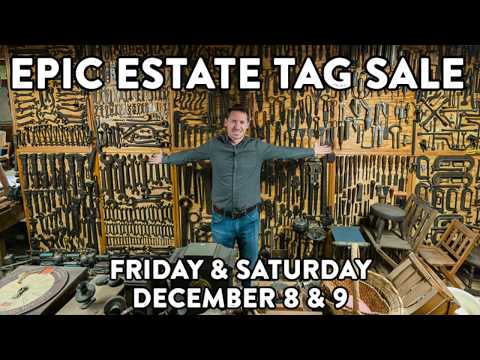
EPIC estate sale in Texas - a picker's dream! - Duration: 3:05.

Hi, I'm Rob Vogt with Vogt Auction Galleries. We are at one of the best

picking sites in all of Texas. This place has been locked up for decades. We've

been trying to get into it for years. Today, the family gave us the keys. Let's

go see what we find. the Dietz family came from Germany to

this part of Texas in the mid 19th century. They were one of the more

prominent families here. Instrumental in setting up the towns of Schertz and

Cibolo. And many local landmarks are named after them this is the Dietz's

family compound. Whoa, this is amazing. Oh, here's a light. Wow, look at all these

tools. This is incredible, there's like 20 of every single type of thing. Fishing

reels, fishing tackle all these rods -Oh it continues. Wow! Look at this. Hold on heres

some lights. This is incredible

This is amazing. Well, so far a good start. Wonder what's

in the other buildings. Let's go find out.

Wow look at all this stuff, got gas cans and old vacuum cleaners. Boy I don't

know. Let's see what's actually in here.

Wow, look at this. Wow, We've got tractor seats here it had come along and oh

really cool old stoves, grinding wheel, bed pans. Wow- gotta watch where you walk in

here. Milk crates- Oh, lots of great crockery look at this. This is amazing.

All this pottery and then these washboards. Well that's about three sheds

out of about ten or twelve here on the property. So we have a lot of work to do

but do stay tuned. We're gonna find some really cool stuff and you'll be

able to come out here at an epic estate sale in December. So watch our

website for more information.

Không có nhận xét nào:

Đăng nhận xét